Bedding & Sleep Guides
Mattress Pads, Protectors, and Covers: How to Choose a Bedding Layer
A bed is built in layers, and the one closest to the sleeper can quietly change how the whole arrangement feels. A mattress pad may bring a touch of cushioning; a protector is usually chosen to guard against moisture and everyday wear. Covers can mean either—or something more specialized. The most useful way to choose is to look past the label and consider construction, fit, care, and the kind of protection or comfort you actually want.
Published November 3, 2026
There is a certain pleasure in making a bed feel finished: the fitted sheet drawn smooth, the duvet falling evenly, the pillows arranged with just enough ease. Beneath that polished surface, however, sits a practical decision. Should the mattress have a protective barrier? Would a quilted pad make it more comfortable? Could an added layer interfere with the feel or temperature of the sleep surface?
These are not merely questions of terminology. Retail descriptions often use mattress pads, mattress protectors, and mattress covers in overlapping ways. One item may offer light cushioning and basic protection; another may be designed chiefly to resist spills. The name alone rarely tells the complete story. Read the construction details and care instructions, then match them to your mattress, household, and preferences.
This guide explains what bedding layers are for, how common materials behave, what to measure before buying, and how to maintain a layer without compromising the mattress underneath. The aim is not to prescribe one perfect setup. It is to make the choices clearer.
First, distinguish the layers
In everyday conversation, the words “pad,” “protector,” and “cover” can blur together. In practice, they suggest different priorities. Treat them as helpful clues rather than guarantees, and confirm the details on the product label.
- A mattress pad is generally a fitted or anchored layer that adds modest softness, cushioning, or surface protection. Quilting and fill can make it feel more substantial than a thin protector.
- A mattress protector is primarily intended to shield the mattress from a particular kind of exposure, such as spills, perspiration, dust, or routine wear. Some are waterproof; others focus on breathability or basic barrier protection.
- A mattress cover is a broad term. It may describe a fitted protector, an encasement that surrounds the mattress on multiple sides, or simply an outer covering. Check whether it closes around the whole mattress or covers only the top.
- A mattress topper is typically thicker and more transformative than a pad. It is used to change the surface feel—adding cushioning or a different response—rather than serving primarily as a hygienic barrier.
The distinctions matter because comfort layers and protective layers do different work. A plush pad may make a firm surface feel softer, but it is not automatically waterproof. A slim protector may guard against spills while barely changing the feel, but it is not intended to provide the cushioning of a topper.
Choose by purpose, not by name
For a softer, more cushioned surface
Look at the amount and type of fill, the quilting pattern, and the overall thickness. A quilted cotton pad can bring a gentle change without creating the deeper, more enveloping feel associated with a substantial topper. Polyester blends may be resilient and easy to care for, while cotton fill can offer a softer, more natural hand. Neither material is universally better; the right choice depends on desired loft, maintenance, and how much you want to alter the mattress.
For a useful point of comparison, the Comfort Quilted Mattress Pad is described as a channel-quilted layer with a cotton-and-polyester fill and a terry microfiber surface. Those details help illustrate what to inspect: the filling, surface fabric, quilting, pocket depth, and care method. A layer with loft may also change how fitted sheets sit, so consider the combined height of the mattress and pad.
For everyday moisture and stain protection
If the priority is guarding against accidental spills, perspiration, or routine household mishaps, seek a protector whose stated purpose includes the level of moisture resistance you need. “Waterproof” is more specific than “protective” or “water-resistant.” Read the product description carefully, including any limits on coverage and mattress depth.
Waterproof construction can involve a membrane or backing beneath the fabric surface. The feel depends on how that barrier is engineered and how it is joined to the top layer. Some protectors are designed to remain quiet and flexible; others may feel warmer or more noticeable. A description such as “crinkle-free” is useful context, but personal comfort is best judged alongside the materials, construction, and any available care guidance.
A waterproof quilted mattress pad combines a quilted surface with a stated protective function. That kind of hybrid design can suit someone who wants cushioning as well as a barrier, but it is worth confirming whether its fit and care requirements work for the particular mattress and household.
For a lighter, more breathable layer
Not every sleeper wants a waterproof barrier or added loft. A breathable protector is intended to provide a layer of everyday protection while preserving airflow and the mattress’s surface character. Look for clear descriptions of the fabric, fit, and the types of wear it is designed to address. “Breathable” describes an intended quality, not a guarantee that a layer will feel cool in every bedroom or for every sleeper.
Natural fibers such as cotton can feel familiar and absorbent, while performance fabrics may be selected for stretch, easy washing, or a closer fit. The weave, backing, and total construction all influence the result. If maintaining a mattress’s original feel is important, a thin, flexible layer may be preferable to a lofty quilted pad.
For a mattress that needs a full enclosure
An encasement usually wraps around the mattress rather than covering only its upper surface. This style may be appropriate when full coverage is specifically needed, but it can be more involved to fit and remove. Confirm the closure type, mattress depth range, and care instructions before choosing one. An encasement should not be assumed to offer a particular level of protection unless that function is stated explicitly.
Materials: what the label can tell you
A fabric name is only one part of the story. The cover, fill, quilting, backing, and elastic each contribute to how a bedding layer feels and performs. Read the full composition wherever it is provided, rather than making a decision based on a single fiber or a broad phrase such as “natural” or “cooling.”
- Cotton is widely used for its familiar, soft feel and ability to absorb moisture. It can appear as a woven cover, knit skirt, or filling. Cotton bedding may still vary considerably in weight, weave, and finish.
- Polyester and microfiber are common in fills and surface fabrics. They can offer durability and straightforward care, though feel and airflow vary with the fabric’s construction and density.
- Wool is used in some toppers and pads for its springy, insulating character and ability to manage moisture. Wool-filled layers may require more careful handling than a standard machine-washable pad, so check the care label.
- Silk can be used as a light filling or in a fabric blend. Care requirements may differ from those of everyday cotton or synthetic layers; dry-cleaning or specialist instructions are possible.
- Waterproof membranes provide a barrier against liquid, but they can affect flexibility, warmth, and sound. The quality and placement of the membrane matter as much as the word “waterproof.”
Natural fibers are not automatically the most breathable, easiest to clean, or suitable for every sensitivity. Likewise, synthetic materials are not automatically uncomfortable. If allergies or skin sensitivities are part of the decision, review the full material information and consult a qualified health professional for individual medical concerns.
Fit is the detail that makes everything else work
A beautifully chosen layer is frustrating if it slips, wrinkles, or pulls the fitted sheet out of place. Fit depends on more than the mattress’s length and width. The depth of the mattress, any existing topper, and the construction of the layer all affect whether it stays smooth through the night.
- Measure the mattress depth. Measure from the bottom edge to the top sleeping surface, including any permanent pillow-top or built-in cushioning.
- Account for existing layers. If a topper will remain on the bed, measure the combined height of the mattress and topper.
- Check the pocket range. Product specifications may state a maximum depth or describe a deep pocket. Compare that number with your measurement rather than relying on a general “fits most” claim.
- Review the attachment. A fitted skirt, corner elastic, or anchor straps can each hold a layer differently. Consider whether the design will be easy to put on and remove.
- Think about sheet fit. A thick pad or topper adds height. Your fitted sheets need enough depth to cover the full stack without straining at the corners.
If the mattress dimensions are unusual, consult its label or manufacturer documentation before ordering. Mattress depth can also change after adding a topper, so an old protector that once fit well may no longer be the right match.
Breathability, temperature, and the feel of the bed
Every added layer becomes part of the sleep surface. A thick quilted pad can soften the first impression of a mattress; a thin protector may preserve it more closely. A waterproof barrier can add practical reassurance, yet its materials may change airflow or feel. There is no single construction that is perfect for every climate, mattress, or sleeper.
Consider how you experience the bed now. If it already feels warm, a plush layer or a densely constructed waterproof protector may not be the first place to add more material. If the surface feels too firm, a pad may provide a modest adjustment, although it cannot correct every comfort issue or replace an unsuitable mattress. If the mattress feels right and the goal is simply to guard it, a low-profile protector is often the more direct approach.
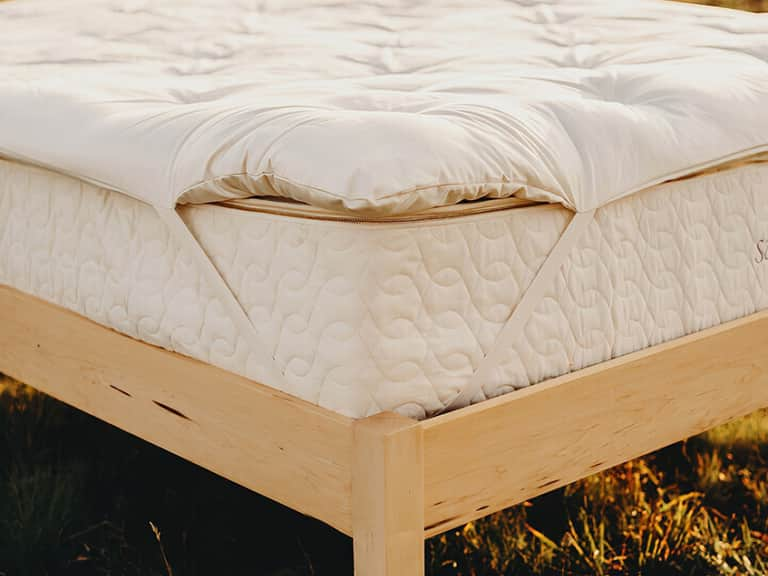
Natural wool offers an example of a material whose role is not limited to cushioning. A wool topper such as the Natural Savvy Woolsy Mattress Topper is described as a generously filled layer in an organic cotton cover, with corner straps for a secure fit. It is a topper rather than a conventional protector, which is precisely why the distinction matters: a comfort layer can be paired with a separate pad or protector when additional surface protection is desired.
When evaluating temperature claims, look for specific construction details and treat broad promises cautiously. Bedroom temperature, bedding, sleepwear, humidity, and individual comfort all contribute to how warm or cool a bed feels. A layer alone cannot control every factor.
Care: protect the layer and the mattress
Maintenance is part of the purchase decision. A machine-washable pad may be convenient in a busy household, while a delicate wool or silk layer may require more attention. Always follow the care label for the item in hand; washing guidance varies by fabric, fill, quilting, and waterproof backing.
- Check the recommended wash temperature and whether the layer can be tumble-dried.
- Use only the detergents and cleaning methods allowed by the care instructions.
- Avoid bleach, fabric softeners, or high heat if the label advises against them; these can affect some fibers or protective finishes.
- Make sure the layer is fully dry before placing it back on the mattress.
- Address spills promptly, while following the mattress manufacturer’s guidance for cleaning the mattress itself.
A removable protector can make routine hygiene easier, but it does not make the mattress indestructible or remove the need to follow the mattress maker’s care directions. Avoid saturating a mattress during cleaning; excess moisture can be difficult to remove and may damage some constructions. If a product has a warranty, review its terms and keep care instructions accessible.
A note on mattress warranties and trials
Warranty coverage differs by manufacturer and product. A bedding layer does not automatically protect a mattress warranty, and a warranty does not necessarily cover stains, spills, or ordinary wear. Before choosing a pad or protector, read the mattress documentation for any care, cleaning, or use requirements. If a question is not addressed clearly, contact the manufacturer directly and retain the response with your records.
Trial periods and return policies for bedding accessories also vary. Some products may have different hygiene rules from mattresses, particularly after use. Check the written terms before opening or laundering a new layer, especially if fit is uncertain. This is a practical reason to measure carefully and keep packaging until you know the item works with your bed.
Common misconceptions, clarified
“Every mattress pad is waterproof.”
No. A pad may add softness or provide light protection without blocking liquid. Confirm that waterproofing is explicitly stated if spill resistance is essential.
“A protector will not change how the bed feels.”
Some low-profile protectors are designed to be subtle, but any layer can alter the surface to some degree. Thickness, fabric, backing, and fit all matter.
“More padding always means more comfort.”
Not necessarily. Added loft can create a softer first impression, but it may also change support, sheet fit, and temperature. A thicker layer is not automatically a better match.
“A mattress cover and a protector are always the same thing.”
The terms can overlap, but a cover may refer to a top-only layer or a full encasement. Check the shape and stated purpose rather than assuming based on the name.
A simple decision framework
Begin with the problem you are trying to solve, then choose the least complicated layer that meets it.
- You want a little more softness: compare quilted pads by fill, thickness, surface fabric, and care requirements.
- You want spill protection: look for an explicitly waterproof protector or pad, then check breathability, fit, and noise-related construction details.
- You want everyday surface protection without much added loft: consider a slim protector and check how it is intended to preserve the mattress feel.
- You want a substantial change in comfort: compare toppers, not just pads, and make sure the resulting bed height works with sheets and fitted covers.
- You need full coverage around the mattress: investigate encasements and confirm that the product’s stated function matches your requirements.
Before deciding, ask yourself: What should this layer do? How much may it change the feel? What is the combined mattress depth? How will it be washed? Will the fitted sheet still stay in place? A few minutes spent on those questions can prevent a mismatch that no elegant product description can fix.
The considered bed
A thoughtful bedding layer is not necessarily the plushest, most technical, or most elaborate option. It is the one that suits the bed beneath it and the way the room is lived in. A protector can provide a practical barrier; a pad can add a gentle cushion; a topper can create a more noticeable change. Some beds benefit from just one layer, while others call for a comfort layer and a separate protector.
Look closely at what each item is made to do. Compare the materials, mattress depth range, attachment, airflow, and care instructions. Then consider the total effect, from the feel beneath the sheet to the ease of laundering. When labels are ambiguous, construction is the more reliable guide. That simple approach turns a crowded vocabulary of mattress covers, pads, and protectors into a clear choice—one made for comfort, upkeep, and the particular life of your bed.
Quick checklist before you choose
- Decide whether your priority is cushioning, spill protection, everyday wear protection, or full enclosure.
- Read the complete material and construction details rather than relying on the product name.
- Measure mattress depth, including any topper, and confirm the specified pocket range.
- Consider how the layer may affect surface feel, airflow, and sheet fit.
- Check washing and drying instructions before purchase.
- Review your mattress warranty and the bedding item’s return or trial terms.